
The Biggest Cottonwood Tree in Arizona Is Around the Corner from my Favorite Coffee Shop
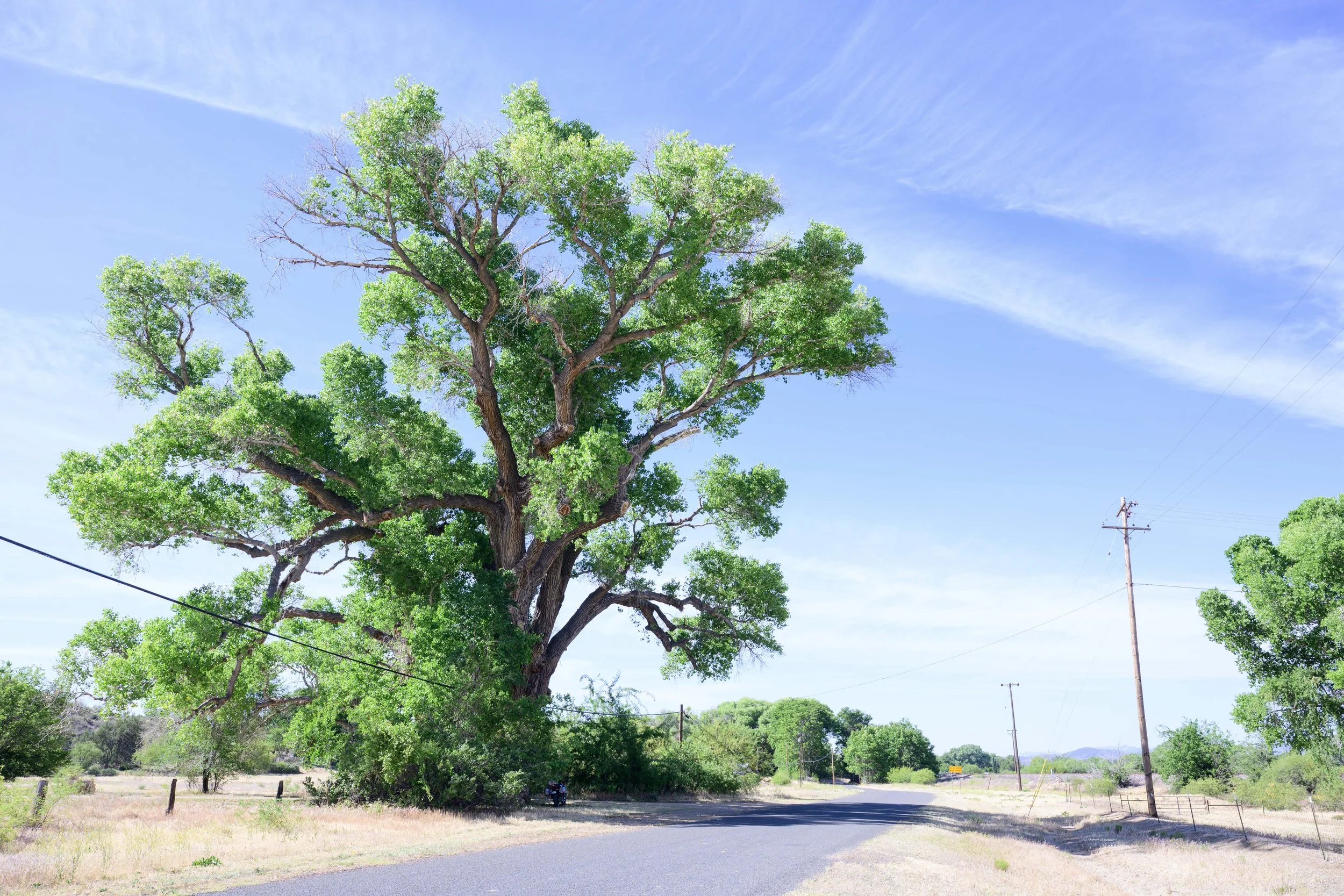
The pride of Skull valley AZ
The Biggest Cottonwood Tree in Arizona Is Around the Corner from a Coffee Shop
I ride through Skull Valley on my motorcycle fairly regularly because there's a coffee shop there called The Forge. It's a good stop. A few weeks ago someone mentioned that the biggest known cottonwood tree in North America was just around the corner. So I went and looked at it. It's something.
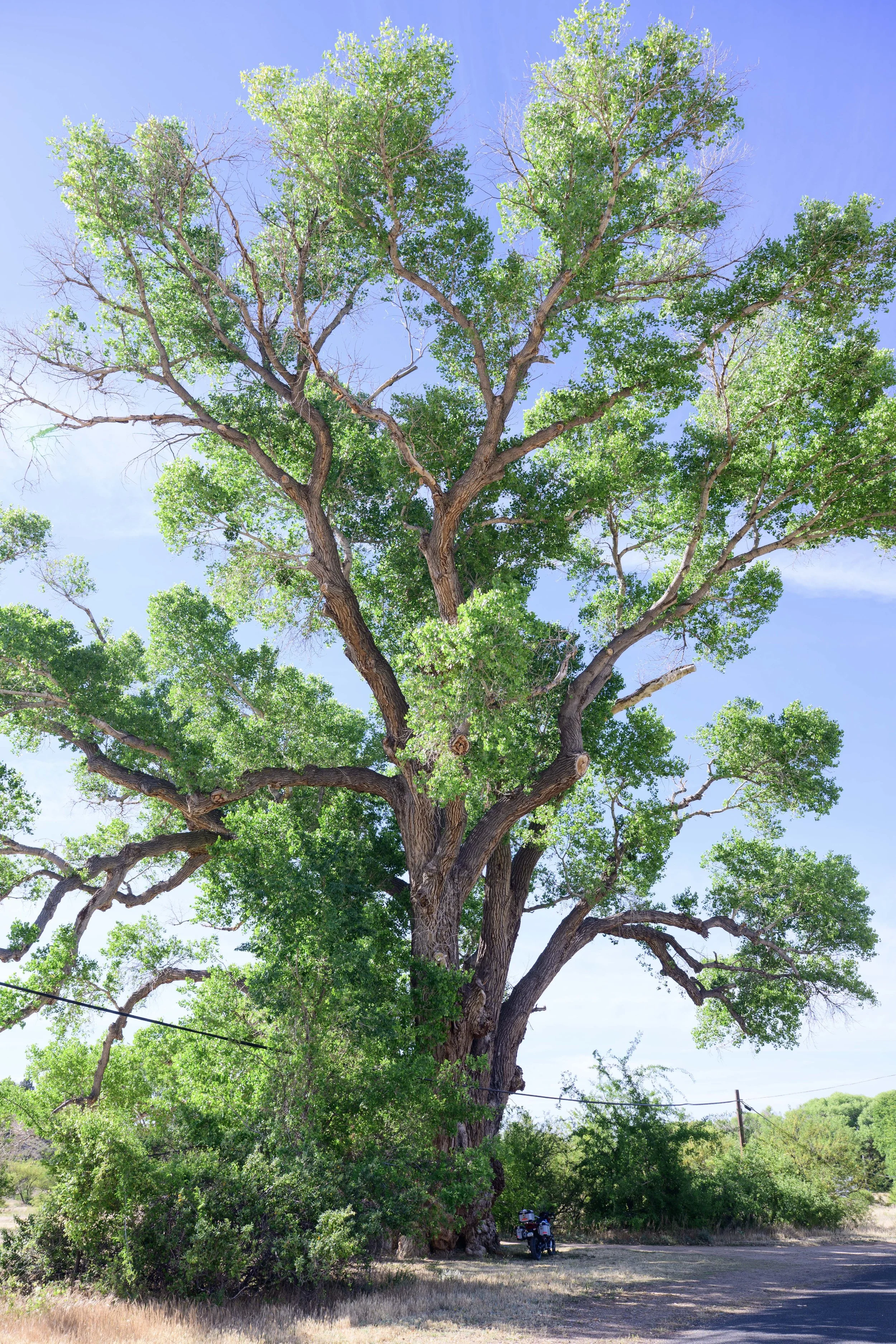
Take notice of the bright young spring leaves
The tree is a Frémont cottonwood→ Populus fremontii , with a trunk more than 46 feet around and a height of 102 feet. I parked my motorcycle directly in front of it so you can get some sense of scale in the photos. The motorcycle is not small. The tree makes it look like a toy.
It was planted in 1917, which means it's over 100 years old. It lived through two World Wars, the Depression, and every Arizona summer since Woodrow Wilson was president. It's on an irrigated lot and was one of four trees planted to mark the property's corners. The other three didn't make the record books.
What even is a cottonwood tree?
Frémont's cottonwood is native to the riparian zones of the Southwestern United States meaning it grows near streams, rivers, springs, and well-watered bottomlands. The name comes from the seeds, which are released in a cotton-like fluff that drifts through the air in early summer. If you've spent time in the Southwest you've seen it and probably wondered what it was.
It's a fast grower that can live over 100 years, and in the right conditions it can reproduce easily from cuttings. In a dry state like Arizona, you know you're near water when you spot a stand of cottonwoods, the bright green leaves signal the presence of water like a beacon, not just for people but for birds and wildlife.
Why does it get so big?
Water, mostly. The tree grows from 39 to 115 feet in height with a wide crown and a trunk up to nearly five feet in diameter under normal conditions. The Skull Valley tree blows past those numbers because it's been on irrigated land for over a century with consistent access to water in a climate that otherwise doesn't offer much of it. A cottonwood with unlimited water is a different animal than one scratching out an existence along a dry creek bed.
Frémont Cottonwood
The inner bark of the Frémont cottonwood contains vitamin C. Native Americans throughout the Southwest chewed it as a treatment for scurvy — making this tree not just the largest of its kind, but one that kept people alive in the desert.

Placard at the base of the giant
What is cottonwood actually good for?
As a woodworker this was my first question. The honest answer is that cottonwood has a mixed reputation. It's traditionally been used for inexpensive commercial products, shelving, crates, children's toys, and has often been overlooked as a low-value hardwood. It's relatively soft, it can tear out badly if you're not careful with grain direction, and plain-sawn cottonwood from most regions is just not very interesting to look at.
That said, perceptions have shifted in recent years, with high-quality cottonwood now being appreciated for its aesthetic appeal and natural sheen.
Native Americans used it extensively for tool making, basket weaving, musical instruments, and the Hopi of northeastern Arizona carved cottonwood root to create kachina dolls. Useful wood is useful wood regardless of what the lumber market thinks of it.
The burl
The base of this tree has a massive burl. As a woodworker, that's what caught my eye after I got over the sheer size of the thing.
A burl is an abnormal growth on a tree caused by stress, injury, or infection and inside one the grain goes in every direction at once, creating figure you can't get from normal lumber. Cottonwood burl is worth going after if it's solid and figured. Even pieces without eyes can have great curl and color variation. Plain Jane cottonwood is pretty miserable to turn, but a figured piece is a different story.
I don't know this tree's burl and I'm not getting my hands on it, but I looked at it for a while. The size alone at the base of a 100-year-old tree on irrigated land in Arizona, that thing could be spectacular inside or it could be nothing. That's the thing about burls. You don't know until you open them up.
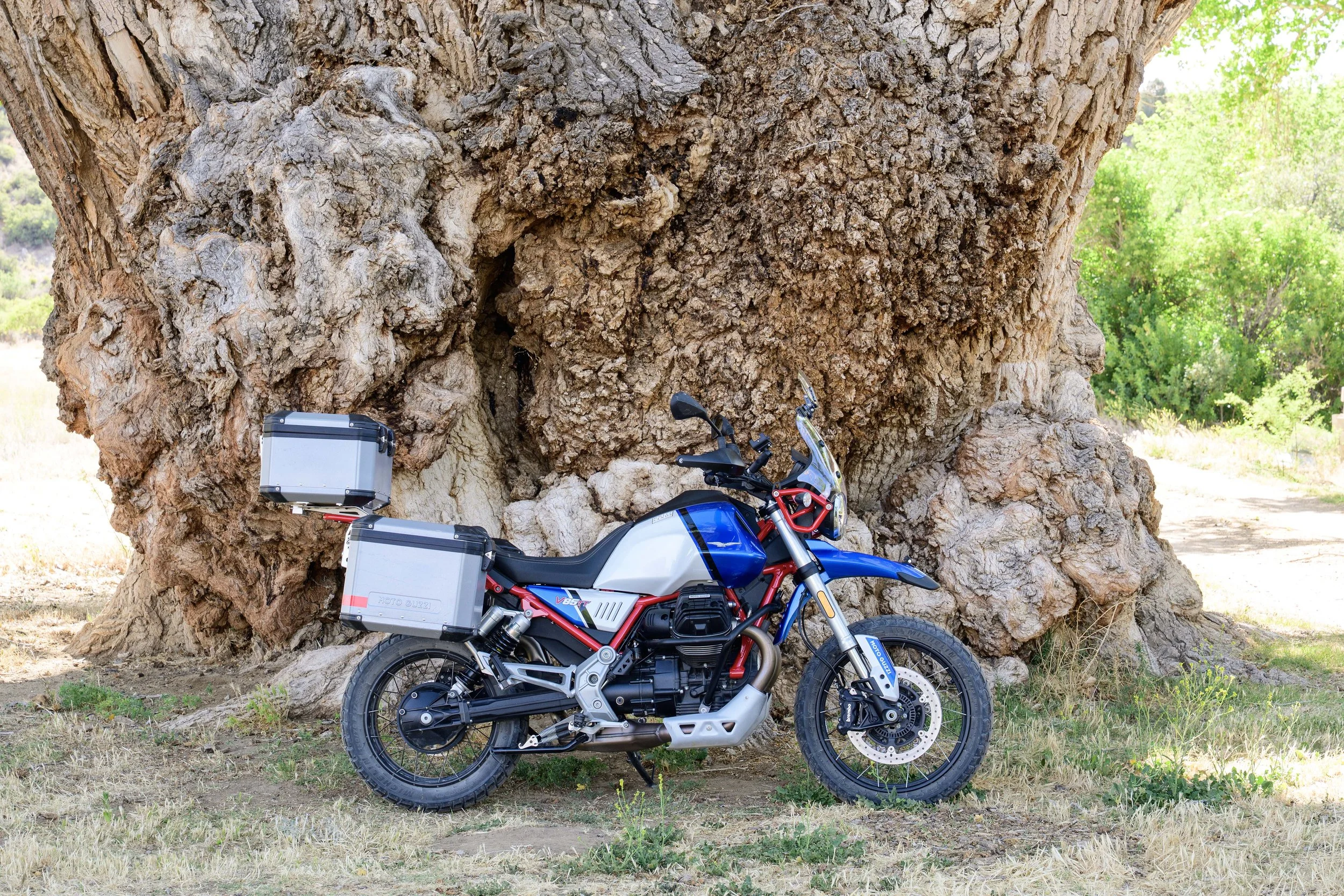
For scale I parked my bike (Moto Guzzi V85tt) in front of the tree trunk
It's worth going to see if you're in the area. The tree sits right off Old Road N, just north of the town of Skull Valley. There's no official park or stopping place, you just pull off on the side of the road. Stop at The Forge first.

A walking cane with a hand-carved violin scroll, thirteen years after I sold the first one. On why handles are the hardest thing I build, what your fingertips know before you do, and how the cane spent a few thousand years as part of getting dressed.