
Manage the Customer (Before They Manage You)
There is a fundamental paradox in the trades. When you’re hired for a renovation or a build, the customer is both your boss and your employee. They pay the bills, sure, but they are also a part of the machinery that makes the job site run. If you don't manage them, they will inadvertently sabotage the very thing they are paying you for: a quality result.
The Reality of Who’s in Charge
You are the professional. They picked you for a reason—presumably because you know how to build things that don't fall down and look beautiful. Because of that, you set the rules. If you work four-day weeks, that’s your choice. If you start at 7:00 AM and leave at 3:30 PM, that’s the schedule. Too many guys let the customer’s desire for a "quiet morning coffee" dictate when the hammers start swinging. If you let the customer pick your hours, you’ll find yourself working until 7:00 PM just to get a day's work done.
The Truth: You decide how and when the work happens. If they don't like it, they can find someone else, but they won't find you.
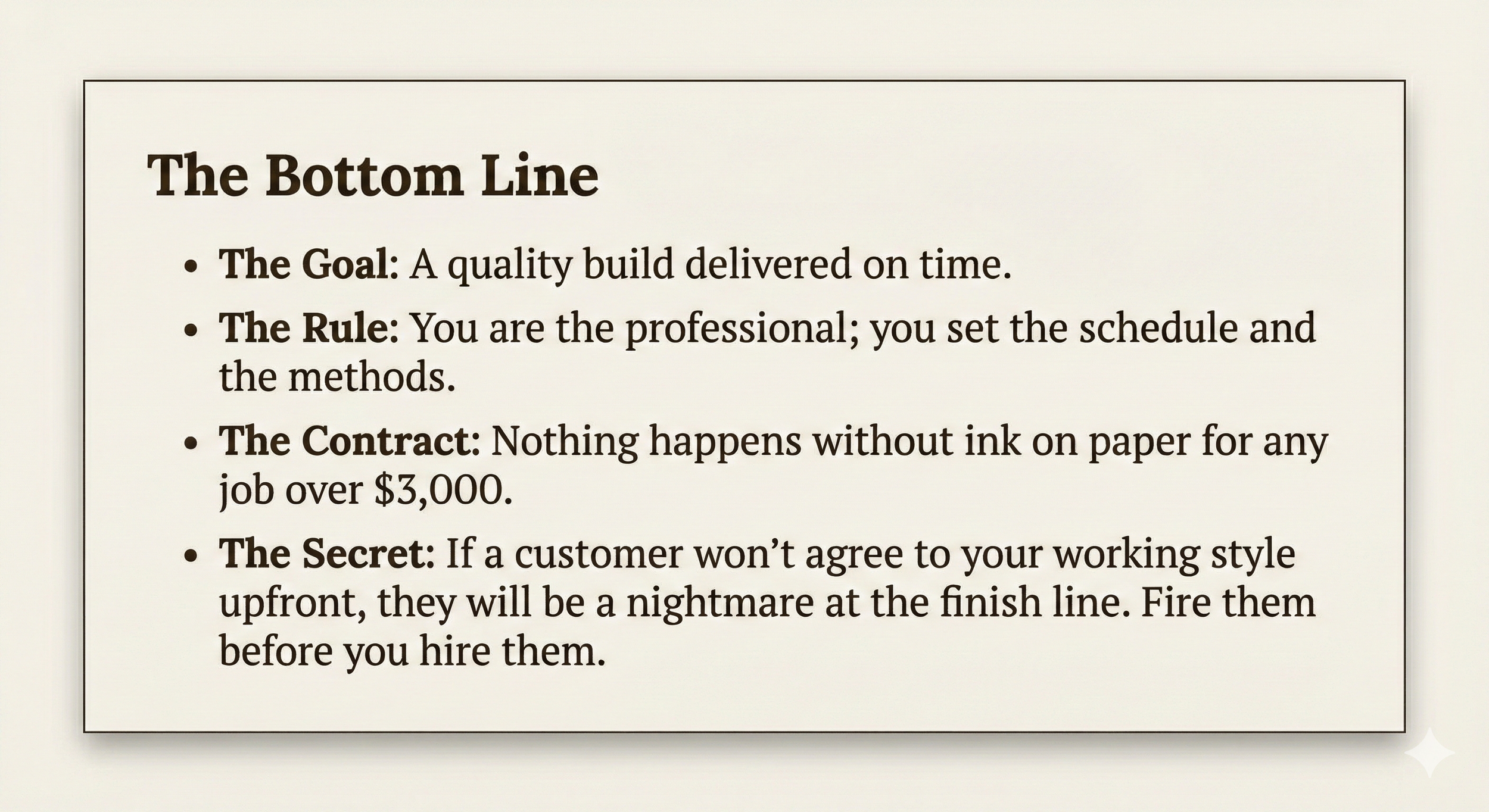
The $3,000 Rule
This is non-negotiable. If the job is over $3,000, you need a contract. Period.
A contract isn't just about getting paid; it’s about clarity. It should outline your working style and your expectations. Ask them upfront: "This is how I work. Is that going to be a problem?" Most people will say yes because they want the work done. If they say no, you’ve just saved yourself six months of misery.
Constant Calibration (Expectation Management)
Managing expectations isn't a one-time conversation at the bid; it’s a daily ritual. You need to be clear about:
Involvement: How much do you want them hovering? (Hint: The answer should usually be "not much.")
Communication: When and how will you update them?
Money: When exactly are the checks due?
As the project moves, you will need to "reset" these expectations. Things change. Wood moves. Inspections get delayed. If you aren't resetting the expectations, the customer will fill the silence with their own assumptions.
The Bottom Line
It is their house, but it is your job.
The customer wants a quality product. To get that, they have to make compromises. They have to respect the process, the schedule, and the boundaries of the craft. If you manage your customers and your subcontractors with a firm hand from day one, you’ll find that the work goes faster, the quality stays higher, and you might actually enjoy being on the job site.
